

Today’s power grids are under increasing strain, from rising instability and greater electrification demands to the rapid expansion of renewable energy sources. Together, these pressures are creating an urgent need for more resilient and responsive power distribution architectures. For many instances, a key solution that offers better resiliency, efficiency, and flexibility is the implementation of microgrids, or localized energy systems capable of operating independently of or alongside the main grid. Microgrids bring together a variety of distributed energy resources (DERs) such as solar, wind, battery storage, and even conventional generators.

In this blog, we explore how microgrids work, the forces accelerating their adoption, the technologies enabling this next generation of distributed energy systems, and why capacitor selection is foundational to long-term reliability.
Key Market Drivers for Increased Microgrid Development
Today, several major trends are rapidly pushing microgrids from niche deployments to core components of modern energy infrastructure.
- Renewable Integration: The global growth of solar and wind power demands localized balancing and storage. Microgrids allow DERs to be integrated and optimized without overloading the main grid.
- AI and High-Density Data Centers: AI workloads are skyrocketing, and as a result, so is the demand for reliable, low-latency power. Microgrids are ideal for these hyperscale and edge computing deployments.
- Environmental-Driven Needs: Natural disasters, such as the recent California wildfires, and grid instability are pushing communities and businesses to look for resilient, self-sufficient energy systems to provide energy continuity, especially for critical infrastructure such as hospitals.
- Decarbonization Goals: Many governments and organizations are increasingly committed to reducing carbon footprint through distributed clean energy.
These converging forces are accelerating microgrid adoption and reshaping the technologies required to support them. One key emerging technology is the solid state transformer (SST), which offers the intelligence and flexibility modern microgrids demand.
What Is an SST and How Does it Work?
Traditional transformers rely on low-frequency magnetic operation and have changed little in decades. An SST replaces these magnetic components with high-frequency, power-electronic conversion stages, delivering significant performance and functional advantages. Using high-frequency isolation and advanced converter stages (AC/DC and DC/DC), SSTs can be made 50 to 70 percent smaller and lighter than conventional transformers while offering far more sophisticated control capabilities.
Beyond their smaller size and lighter weight, SSTs unlock a range of advanced grid-management functions not possible with conventional designs, including:
- Real-time voltage regulation
- Reactive power compensation
- Harmonic mitigation
- Power-quality enhancement
- Fast fault detection and isolation
These capabilities position SSTs as foundational components for digitally controlled distributed energy networks.
Why SSTs Are a Transformative Technology for Microgrids
SSTs are uniquely suited to address many of the core challenges modern microgrids face. Acting as an intelligent interface between the main grid and the localized network, an SST can manage bidirectional power flow and support seamless transitions between grid-connected and isolated operations, which is an essential capability for systems that must remain stable during disturbances. The advanced power-electronic architecture of SSTs also strengthens the integration of DERs. By regulating voltage, filtering harmonics, and precisely controlling power flow, SSTs help microgrids maintain smooth operation, even when resources fluctuate.
Beyond these grid-interaction benefits, SSTs also support the accelerating shift toward DC-centric infrastructure. Many emerging microgrid applications, such as high-density data centers and fast EV charging, depend on robust DC distribution. SSTs can supply DC directly, improving system efficiency and reducing the number of conversion stages required. Finally, because SSTs respond to electrical disturbances almost instantaneously, they offer superior protection and fault isolation. This rapid detection and response enhances the reliability of sensitive loads and contributes to the overall resilience of the microgrid.
The Critical Role of Capacitors Inside SSTs
While SSTs depend on fast-switching semiconductors and sophisticated control algorithms, capacitors are equally essential to their operation and reliability. Key capacitor functions in the SST include:
- DC-link energy buffering between conversion stages
- Coupling elements in capacitor-coupled topologies
- High-frequency filtering to manage harmonic content
Given the harsh electrical and thermal environment inside SSTs, capacitor reliability directly impacts long-term system performance. Therefore, selecting the right capacitor is a critical step.
Selecting the Right Capacitor for an SST
Because SSTs operate in electrically and thermally demanding environments, selecting the right capacitor technology is critical. The key parameters to consider, and why, are covered in the table below.
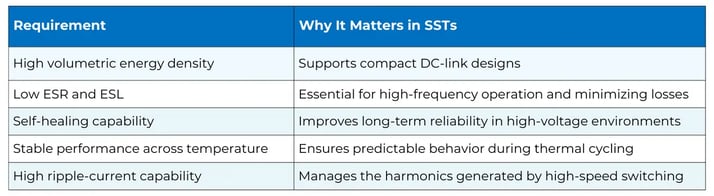
High-Performance Film Capacitors for SST Applications
Knowles provides a range of film capacitors engineered for demanding power-conversion environments. Our high-temperature, humidity, and bias (THB)–rated film capacitors, such as our CD brand BLS capacitors, are specifically designed to deliver the reliability required in modern SSTs and microgrids. These capacitors offer:
- Excellent thermal stability up to 125°C
- Superior humidity and bias endurance
- High ripple-current capability
- Long operational life in harsh environments
- AEC-Q200 qualification for automotive-grade electrical and mechanical operation
Enabling the Future of Distributed Energy
As the energy landscape continues to evolve, microgrids are becoming foundational elements of modern power infrastructure. SSTs deliver the intelligence, compactness, and control needed to unlock the full potential of these systems. Behind every high-performing SST is a portfolio of precision-engineered passive components, including capacitors, that ensure stability, efficiency, and long-term reliability. At Knowles, we are committed to delivering the capacitors required to power these innovative solutions.
Learn more about our CD brand BLS DC Link capacitors or explore our entire capacitor portfolio.