Quadrature hybrid couplers are basic building blocks for many RF and microwave systems. For these couplers, the input splits into two output signals, of equal magnitude, with a 90 degree phase difference. Quadrature hybrid couplers provide improved input match for unbalanced loads. Energy splits evenly between outputs, and some energy is reflected back due to mismatch. For example, in Figure 1, there is a 90 degree phase difference between the two outputs, so the energy reflected at point A is 180 degree out of phase and cancels at the input port. At point B, the energy is in phase and sums at the isolated port, which is terminated.
Balancing Performance with Compact Quadrature Hybrid Couplers
Topics: RF and Microwave
A Guide to Snubber Capacitor Selection for SiC-Based Switching Converters
Today, most converter circuits now include semiconductors and switches made of silicon carbide (SiC) instead of plain old silicon (Si). This is because when silicon and carbon are combined, the resulting material, SiC, has excellent mechanical, chemical, and thermal properties. Therefore, SiC-based converters can handle voltages up to 10 times greater than converters using just Si while also offering lower losses. These characteristics make these converters an excellent option for applications such as power electronics, industrial devices, and electric vehicle (EV) charging stations. In this post, we dive into the advantages of using snubber circuits to protect SiC-based converters and discuss how to further increase these efficiencies by focusing on capacitor selection.
Wilkinson Power Dividers and Feed Networks – A Brief Overview
The Wilkinson Power Divider, designed by Ernest Wilkinson in the 1960s, uses quarter wave transformers to split an input signal into two equal phase output signals. Since the design is reciprocal, Wilkinson Power Dividers can also be used as a power combiner. With this flexibility, they are widely used in many RF and microwave communication systems, including those with multiple channels or complex feed networks.
Topics: RF and Microwave
Microgrids and Solid State Transformers: Powering the Future of Resilient Energy
Today’s power grids are under increasing strain, from rising instability and greater electrification demands to the rapid expansion of renewable energy sources. Together, these pressures are creating an urgent need for more resilient and responsive power distribution architectures. For many instances, a key solution that offers better resiliency, efficiency, and flexibility is the implementation of microgrids, or localized energy systems capable of operating independently of or alongside the main grid. Microgrids bring together a variety of distributed energy resources (DERs) such as solar, wind, battery storage, and even conventional generators.
Topics: Capacitor
Radio frequency (RF) power dividers are designed to split an incoming signal into multiple outputs such that there’s a portion of the original signal’s power in each output. Given their critical function, power dividers play a particularly important role in antenna systems, telecommunications, and signal processing.
Topics: Capacitor, Military and Aerospace, High Reliability
Power electronics play a critical role in converting and managing electrical energy efficiently. As electric vehicles (EVs), renewable energy systems, and consumer electronics quickly become more powerful, the demand for high-voltage power electronics is quickly increasing. This means the importance of components like bootstrap capacitors has grown significantly.
Topics: Capacitor
A Year of Evolution and Innovation: Knowles’ Top 5 Blogs of 2025
In 2025, our team continued to share insights intended to help engineers navigate evolving technologies, design challenges, and application demands. We hope our technical resources and industry perspectives have supported your work throughout the year, and we sincerely appreciate your continued trust and readership.
Topics: Capacitor
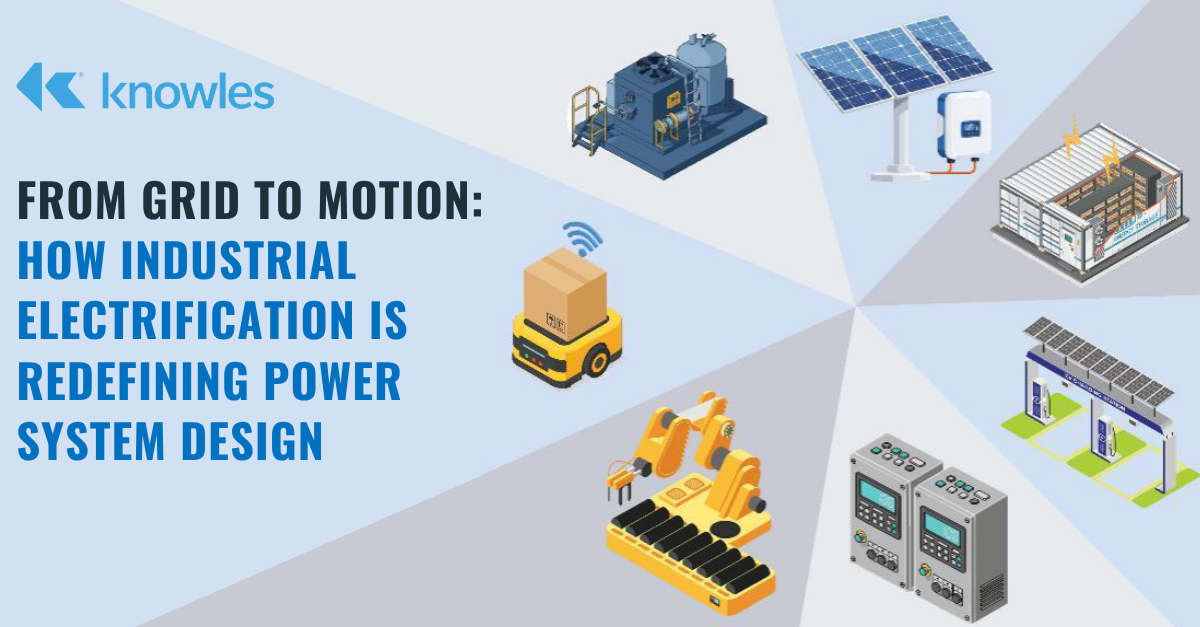
Powering the Energy Transition from the Inside Out
By 2050, electricity is expected to more than double its share of final energy consumption, jumping from 23 percent to 52 percent. As a result, the way the world generates, transmits, stores, and uses energy is changing.
Topics: Capacitor
Why Q Factor and Capacitor ESR Matter in Power and RF Resonant Circuits
The performance of a resonant circuit comes down to its components. Two key factors, Q factor and capacitor equivalent series resistance (ESR), determine how efficiently energy moves through a resonator and how selectively it responds at its designed frequency.
Topics: Capacitor
As demand for high-efficiency and high-power-density inverters continues to grow, the so-called “flying” capacitor multilevel inverter is emerging as a strong choice for many power electronics systems. Since these capacitors can “float” to different electric potentials depending on the connected semiconductor switching structure and state, they help balance out voltage level differences due to manufacturing tolerances, temperature variations, and other factors. These capacitors are also helpful in balancing voltage across the structure by temporarily storing and releasing energy as needed, increasing power density and quality, and optimizing the use of existing voltage availability.
Topics: Capacitor