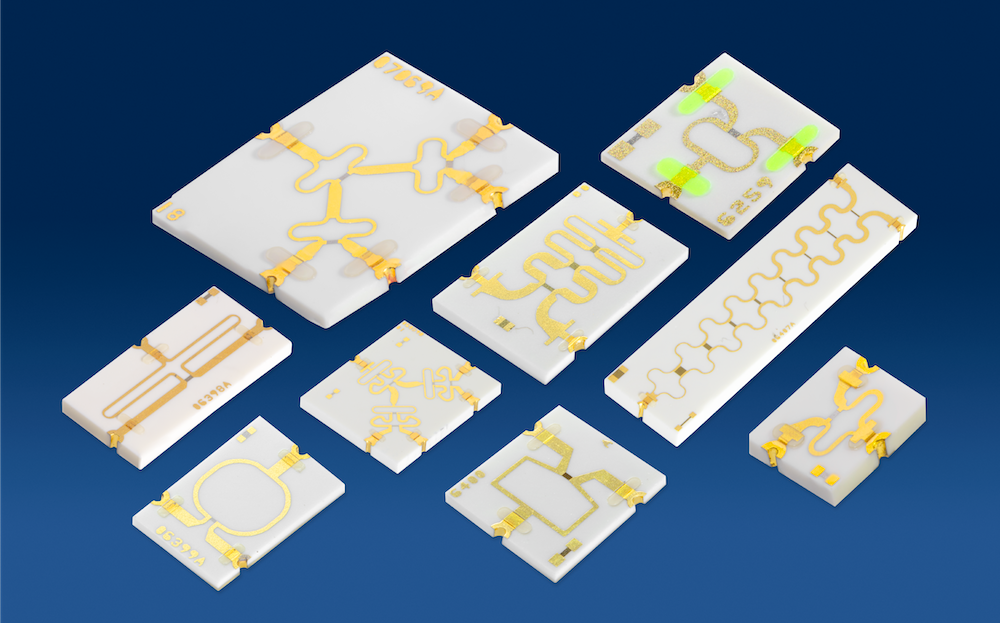
The Wilkinson Power Divider, designed by Ernest Wilkinson in the 1960s, uses quarter wave transformers to split an input signal into two equal phase output signals. Since the design is reciprocal, Wilkinson Power Dividers can also be used as a power combiner. With this flexibility, they are widely used in many RF and microwave communication systems, including those with multiple channels or complex feed networks.
Wilkinson Power Dividers and Feed Networks – A Brief Overview
Topics: RF and Microwave
Since our acquisition of Integrated Microwave Corporation (IMC) in 2020, we have extended our range of RF and microwave filtering solutions to include a wide variety of ceramic coaxial resonators, lumped element filters, and cavity filters from the VHF to the Ka band. During this time, we’ve also continued to innovate on and expand our product offering for one of our most popular filter types – the microstrip filter.
Topics: RF and Microwave, Filtering
How High-Q Ceramic Filters Help Engineers Overcome GNSS Jamming
As engineers embed receivers for Global Navigation Satellite Systems (GNSS), like GPS and Galileo, into systems ranging from autonomous vehicles to precision agriculture, the RF environment is becoming more crowded, and it’s more difficult to maintain signal integrity.
Topics: RF and Microwave, Military and Aerospace, Filtering
X2Y® technology, which was originally developed by X2Y Attenuators, LLC, is based on a proprietary electrode arrangement embedded in passive components that can be manufactured using a variety of dielectrics. Using this innovative technology, Knowles Precision Devices manufactures high-performance multi-layer ceramic capacitors (MLCCs) that we then use to create a variety of off-the-shelf and custom bypass and noise decoupling capacitors and electromagnetic interference (EMI) filters. Let’s look at how building these components with X2Y is different than using a traditional ceramic MLCC and the resulting benefits.
Topics: RF and Microwave, Filtering
At Knowles, we closely monitor the trends and market conditions that impact our customers’ design needs. As a specialty components manufacturer with in-house ceramic and thin film manufacturing expertise, we can quickly adapt to these changing needs to make it easier for customers to find exactly what they are looking for. That’s why in 2023 we released numerous new off-the-shelf DLI brand microwave devices.
These components are made with our temperature stable ceramics, are incredibly small compared to other similar parts on the market, and cover a range of frequency bands, from the S band to the V band. Below is a summary of the capabilities of our latest microwave product offerings.
Topics: RF and Microwave
This is the fifth installment in our RF Components for Radar series. In the first installment, we provided an overview of the key functional units in radar, including duplexing, filtering, power amplification, waveform generation, low-noise amplification (LNA), receiving and analog-to-digital conversion (ADC). Since then, we’ve covered duplexing, switch filter banks and filters in detail. In this post, we’ll discuss what phase can tell us about filter performance in radar applications.
Topics: RF and Microwave
Switch Filter Banks for Agile RF Receiver Design in Radar
This is the third installment in our RF Components for Radar series. In the first installment, we provided an overview of the key functional units in radar, including duplexing, filtering, power amplification, waveform generation, low-noise amplification (LNA), receiving and analog-to-digital conversion (ADC). Here, we’ll focus on a particular form of filtering technology: switch filter banks.
Topics: RF and Microwave
This is the second installment in our RF Components for Radar series. In the first installment, we provided an overview of the key functional units in radar, including duplexing, filtering, power amplification, waveform generation, low-noise amplification (LNA), receiving and analog-to-digital conversion (ADC). Here, we’ll focus on duplexing.
Topics: RF and Microwave, Military and Aerospace
Radar systems are designed to detect and identify an object’s location. They use short bursts of energy to transmit radio frequency (RF) and microwave signals and gather information from the echoed signal returned by the object.
Here, we’ll introduce radar, including its key functional units and technological evolution.
Topics: RF and Microwave
Understanding The Basics of Ceramic Coaxial Resonator Filters
Before jumping into a discussion on ceramic coaxial resonators, it is important to understand what a resonator is and how these electrical components work. In general, a resonator is an essential component for constructing a bandpass filter since the resonator is what will allow specified frequencies, or bands of frequencies, to pass through the filter as shown in Figure 1.
Topics: RF and Microwave, Filtering